Why Checklists Fail: 5 Key Reasons Boxes Get Checked but Quality Doesn't Improve
In quality management systems, checklists are widely regarded as a primary tool for risk identification. They help evaluate technological processes across quantitative and qualitative metrics, equipment condition, and occupational safety. Yet despite having checklists in place at every stage of production, downtime and accidents still occur. The root cause? Not the checklists themselves, but how they're used.
Let's explore how to avoid checklist pitfalls, using the example of an ExxonMobil subsidiary and its implementation of the logsheet.ai electronic platform. Management had grown frustrated by a lack of visibility into real performance indicators—everything looked flawless on paper, but equipment failures were happening far too often. A closer examination uncovered several significant—yet entirely fixable—issues.
1. Ritualistic Filling
Problem:
The first issue we encountered when reviewing the workflow was that employees were checking items not against actual readings, but purely for the sake of ticking boxes—often without even glancing at the instruments.
For example, the pressure on the separator needed to be recorded, yet it had remained steady at 4.2 atm for several consecutive shifts. The operator knows that the regulation requires a value between 4.0 and 4.5 atm, so without looking, they simply mark the checklist as "normal."
Their reasoning? Scrolling through a lengthy checklist, finding the correct line, and verifying whether each value falls within specified limits takes too much time. It feels easier to check boxes out of habit, with only a cursory glance at the equipment, than to thoroughly address every item.
Consequences:
While the checklist ostensibly recorded daily compliance with process standards, the reality told a different story:
- The shift log provided no actionable information;
- Equipment frequently operated in emergency mode;
- Two unexpected breakdowns occurred in the same area within a single week;
- Emergency repairs replaced scheduled maintenance;
- It was impossible to pinpoint the critical moment when equipment performance began to degrade.
Ultimately, working with such equipment became simply unsafe for personnel.
Solution using logsheet.ai:

We proposed replacing checkboxes with numerical values (temperature, pressure) or selection from a drop-down list. This initially met with resistance from operators, but after a couple of weeks, they adapted to the new format and overcame their initial reluctance. To boost buy-in, we also had to reduce the overall information load.
2. Information Overload
Problem:
Depending on the equipment, the checklists filled out by operators contained an excessive number of items—anywhere from 20 to 40 or more. In practice, however, employees only genuinely reviewed the first few and the last few lines; everything in between was checked off by default. For instance, separator pressure—a critical indicator—was listed on line 12, yet it was routinely marked as "normal" without ever being verified.
Consequences:
Operators missed key indicators that directly affect the technological process, because too much time and effort were wasted recording non-essential data.
Solution:
We proposed limiting checklists to a maximum of 10–15 items and breaking longer lists into sections. However, we encountered resistance from management, who feared that omitting any parameter could compromise operational safety. To address this, we analyzed the critical indicators for each section and configured the logsheet.ai checklists as follows:
- Displaying only those parameters relevant to the current task, while hiding irrelevant ones;
- Requiring the system to prioritize critical items first, with the rest marked as optional (for example, if a pressure sensor detects an abnormal value, a comment field and photo upload appear automatically);
- Adapting to shifts and sections, so that only the items needed for a specific case remain visible;
- Showing additional items only when certain parameter values are triggered; they remain hidden under normal conditions.
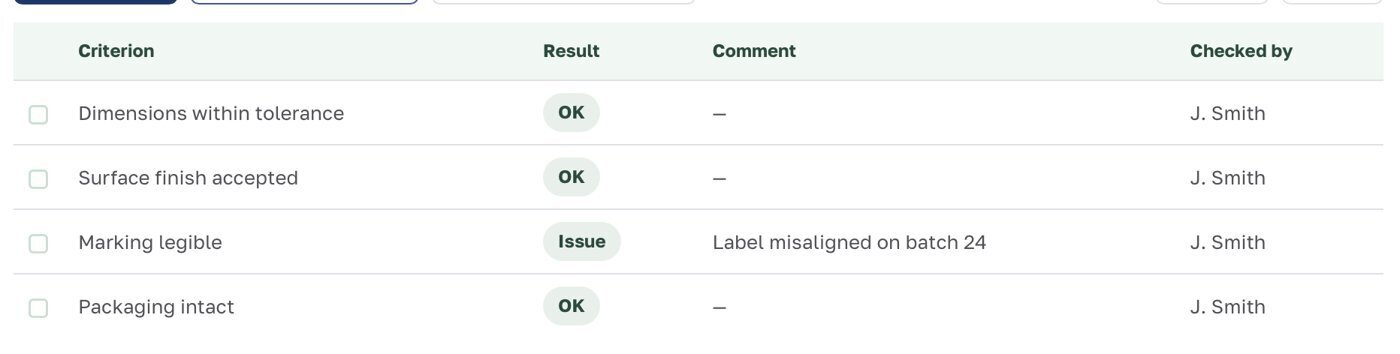
Reducing the number of items allowed operators to spend more time carefully filling out checklist metrics, and the reports became significantly more informative.
3. Lack of Feedback
Problem:
The next issue we encountered on the production floor was that operators had no visibility into the impact of their work. They operated under the impression that their sole responsibility was to complete the checklist—not to ensure that the information entered was accurate and thorough. Management neither monitored the completion process nor enforced rewards or penalties for non-compliance. As a result, operators began to undervalue the importance of honest reporting and simply checked boxes without verifying actual metrics.
Solution:
To enable clearer performance assessment, we integrated the completed data into production reports and dashboards accessible to both employees and management. Using the example of dynamic equipment checks for extraneous sounds, we compiled a report that revealed the following:
- Not a single checklist indicated any issues with the equipment;
- When cross-referencing this list with breakdown records, we found that the checklist data did not match—indicating it contained false information;
- We verified equipment breakdown dates against checklist dates and the names of responsible personnel who performed checks immediately before each failure;
- This allowed us to identify employees who had filled out checklists without accounting for actual values.
This type of feedback demonstrates to employees that their work is being monitored, that verification is inevitable, and that checklists must be completed conscientiously—since the information they provide is actively used to analyze production operations.
For management, this feedback becomes a valuable tool for assessing individual employee KPIs. Moreover, both the quality and the timeliness of checklist completion can be used to evaluate performance.
4. Completing the Checklist at the End of the Shift from Memory
Problem:
An employee who considers themselves experienced and extremely busy during work hours fills out the checklist from memory at the end of the shift, rather than verifying it against actual production data. This leads to inaccuracies and errors, and makes it nearly impossible to determine at what point during the day something went wrong—or who is responsible.
Solution:
We proposed filling out the checklist via a mobile device. When using a mobile device, the operator's actual location and the time of data entry are automatically recorded, allowing us to flag late entries. After conducting an analysis using this method, we identified several employees who had neglected to complete their checklists on time.
One of them, John Henderson, was entering data from the office at 8 PM—information that should have been recorded by him at 2 PM on the shop floor. Based on this analysis, we compiled statistics, and company management introduced an additional KPI for recording metrics at the point of measurement.
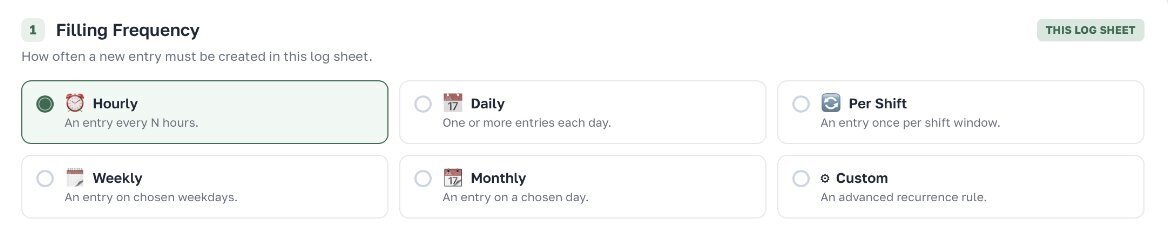
To prevent further violations, we set up an automated schedule for the system to request data entry at designated times. Data entry can now be performed not only manually but also by recording voice messages.
5. The Checklist Isn't Integrated into the Shift Handover Process
Problem:
Another factor reducing the effectiveness of the company's checklists was that they weren't integrated into the shift handover process. The incoming employee encountered the same problems as the outgoing one, wasting time on decisions that had already been made.
For example, at a well pad, the day shift encountered an issue where the electric actuator on the valve dosing methanol into the well was knocking and failing to reach its final position. The problem was solved by manually turning the valve three additional turns, as the limit switch was sticking in the cold. However, the night shift was only given a brief and incomplete verbal handover about the solution. When the problem recurred, another employee opened the valve too far, forcing the methanol supply to be shut off and spending 3.5 hours on repeat diagnostics. Had he been familiar with the information entered into the electronic operations logbook by the previous shift, solving the problem would have taken just a few minutes.
Solution:
Employees were asked to begin their shift by filling out a checklist in the logsheet.ai system, which is automatically generated based on information from the previous employee.
Additionally, a "traffic light" system was introduced that displayed real-time quality checks on the checklist completed by the previous shift. It included the following assessments:
- the physical location of the employee who completed it;
- the time difference between the event and the time of completion;
- the speed with which the employee completed the checklist – indicating whether they filled it out thoroughly or simply rushed through it without thinking.
Checklists became operational
As a result, by automating several key processes, we restructured the company's checklist system as follows:
- limited it to 10–15 items, dividing larger ones into sections;
- encouraged real-time completion, facilitated by the mobile version and voice input;
- suggested how to resolve organizational issues by introducing KPIs for the quality and timeliness of checklist completion;
- collected statistics, which were used to analyze completion results;
- configured checklists during shift handover.
Thus, the checklist became more than just a list of checkboxes—it evolved into a truly useful tool that enables an informative shift report, timely detection of deviations, and corrective action before serious breakdowns and accidents occur.


Comments
Post a Comment